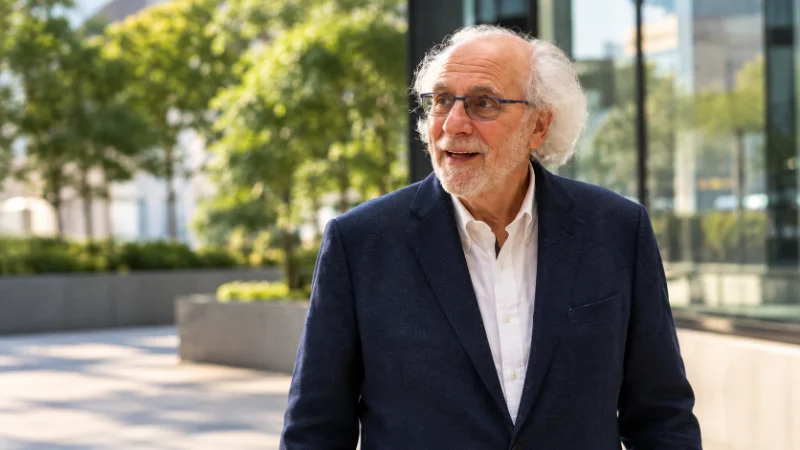
Peter Tuchman has spent four decades on the floor of the New York Stock Exchange, and his net worth is most often estimated at around $20 million, though figures from different outlets range as low as $1.5 million. Most people recognize him not from a boardroom photo but from a very different kind of image: white hair standing on end, mouth open, arms thrown up during a wild trading session. That look earned him the nickname “Einstein of Wall Street” and made him one of the most photographed traders in the building. Tuchman took a summer job on the floor in 1985 and never left. His story since then includes multiple market crashes, a brush with death during COVID-19, and the loss of both his wife and his brother within a few years of each other.
From Teletypist to Broker: How Peter Tuchman Built His Career
Peter Michael Tuchman was born on December 24, 1957, in New York City. His father, Marcel Tuchman, survived the Holocaust and later trained as a physician in Germany before moving the family to the United States. His mother, Shoshana Itzkovich, was born in Hungary. Tuchman grew up on Manhattan’s Upper West Side alongside his older brother, Jeffrey.
He studied agriculture, international finance, and economics at the University of Massachusetts Amherst, then briefly considered a master’s degree in landscape architecture before dropping out and moving back to New York City. A patient of his father’s, who ran a brokerage, helped him land a summer job on the exchange floor, and on May 23, 1985, he started as a teletypist for Cowen and Company. He never left the floor after that.
Tuchman became a broker on April 17, 1988. He spent much of the 1990s specializing in convertible arbitrage at Lee Securities, then worked as an independent broker before joining Quattro Securities in 2011. He is currently listed on FINRA’s BrokerCheck as a broker with TradeMas Inc.
On an active day, Tuchman says he can move a couple hundred million dollars worth of stock, and his single largest trade involved 10 million shares. That money belongs to institutional clients, not to Tuchman personally. For most of his career, he has said he does not personally own stock, reasoning that worrying about his own gains and losses would pull his focus away from serving customers.
Peter Tuchman’s Net Worth: What the Estimates Actually Say
Tuchman has never publicly disclosed his personal finances, and as a floor broker rather than a hedge fund founder or public company executive, he is not required to file the disclosures that make some Wall Street fortunes easy to verify. That gap is why estimates of his wealth vary so widely across financial media.
The figure cited most consistently, including by outlets like Celebrity Net Worth and several financial biography sites, puts Tuchman’s net worth around $20 million, built up gradually through decades of trading commissions rather than one large payout. Other public estimates place the range anywhere from $5 million to $25 million, and at least one source lists a considerably lower figure of $1.5 million, reflecting how differently outlets weigh decades of floor income against the reality that a broker’s earnings depend on commissions and client volume rather than personal ownership of stock.
Beyond his work on the floor, Tuchman has added income through financial education programs, speaking engagements, consulting, media appearances, and licensing his image and story for advertising. Those additional streams are one reason multiple outlets treat his wealth as diversified rather than tied to a single paycheck.
Life Away From the Floor: Peter Tuchman’s Wife and Family
Tuchman was married to Lise Zumwalt Tuchman, a filmmaker and producer, for most of his adult life. Together they raised two children, Benjamin and Lucy. Benjamin followed his father onto the exchange floor and became a broker there himself, keeping the family connection to the NYSE going into a second generation.
Lise died of cancer in August 2023. Tuchman’s older brother, Jeffrey, an award-winning documentary filmmaker best known for his work on The Man from Hope, died of cancer in 2017 at age 62. At the time of his death, Jeffrey had been working on a documentary called Testimony, centered on their father’s account of a war crimes trial tied to the Holocaust.
Tuchman has kept most details of his family life private and rarely discusses his children in interviews beyond confirming their names. In conversations about money and success, he has said he has no interest in showing off, once telling an interviewer he does not need photos of himself on the back of an expensive car with stacks of cash to feel successful.
Surviving Crashes and a Brush With Death
Tuchman’s four decades on the floor cover nearly every major shock the market has produced. He was there as a clerk during Black Monday in 1987, when the Dow fell more than 22 percent in a single session. He worked through the dot-com collapse in the early 2000s, the September 11 attacks, and the 2008 financial crisis, including the 777-point single-day drop in the Dow that followed the collapse of Lehman Brothers.
None of those matched what happened to him personally in March 2020. Tuchman contracted COVID-19 early in the pandemic and has said doctors gave him three months to live. He survived, though he has described lingering health effects from the illness in interviews years later.
Tuchman has also been vocal about how the job itself has changed. He has said electronic trading did not make the floor more productive, arguing that the shift away from human traders cost the exchange some of the communication and transparency that used to come with open outcry trading.
Why Peter Tuchman Still Matters on Wall Street
Floor trading now accounts for a shrinking fraction of total market volume, with algorithms executing most trades in fractions of a second. Tuchman remains one of the few visible reminders that a market still runs, in part, through people standing in a room reacting to numbers in real time.
That visibility is exactly why editors keep reaching for his photo. When a network or wire service needs an image to represent a market crash or a record rally, Tuchman’s face has become shorthand for the emotion behind the number, giving readers something to react to that a chart alone cannot provide.

At an age when many in his field have long since retired to advisory roles, Tuchman still works the floor, mentors younger traders, and teaches financial education courses. His son’s presence on that same floor suggests his particular version of Wall Street, loud, expressive, and stubbornly human, is not done yet. His own summary of the philosophy behind it all is blunt: buy stocks, not stuff.